Tiefenhirnstimulation: Unterschied zwischen den Versionen
Cezary (Diskussion | Beiträge) Fachliche Durchsicht: 2 Stellen berichtigt oder ergänzt, mit Einzelnachweisen |
Cezary (Diskussion | Beiträge) K Links von http auf https umgestellt – nur Adressen, deren Server über https erreichbar ist (geprüft am 24.09.2026); dx.doi.org auf doi.org |
||
| Zeile 1: | Zeile 1: | ||
Die '''Tiefenhirnstimulation''', auch genannt '''tiefe Hirnstimulation''' oder engl. '''Deep Brain Stimulation (DBS)''' ist ein medizinischer Eingriff in das Gehirn, mit dem krankheitsbedingte Fehlleistungen korrigiert werden sollen. Dabei werden dem Patienten Elektroden [ | Die '''Tiefenhirnstimulation''', auch genannt '''tiefe Hirnstimulation''' oder engl. '''Deep Brain Stimulation (DBS)''' ist ein medizinischer Eingriff in das Gehirn, mit dem krankheitsbedingte Fehlleistungen korrigiert werden sollen. Dabei werden dem Patienten Elektroden [https://de.wikipedia.org/wiki/Implantat implantiert], die über [https://de.wikipedia.org/wiki/Subkutan subkutan] verlegte Leitungen mit einem Impulsgeber im Bereich der Brust oder dem Oberbauch verbunden sind. Das populär ''Hirnschrittmacher'' genannte System stimuliert mit minimalen elektrischen Impulsen fehlgesteuerte Hirnregionen. Bis 2020 wurden weltweit bereits über 160.000 solcher Impulsgeber eingesetzt, die meisten zur Behandlung der Parkinson-Krankheit.<ref name="TREVEN2020">Treven M, Brücke C: Die tiefe Hirnstimulation. ''psychopraxis. neuropraxis'' 2020; '''23'''(3): 138–141. [https://doi.org/10.1007/s00739-020-00637-5 DOI]. Im Wortlaut: „Bei weltweit bereits über 160.000 implantierten Aggregaten, in den meisten Fällen zur Behandlung eines M. Parkinson …“ Am 23.09.2026 gelesen.</ref> | ||
Etablierte Anwendungsgebiete sind unter anderem die [ | Etablierte Anwendungsgebiete sind unter anderem die [https://de.wikipedia.org/wiki/Parkinson-Krankheit Parkinson-Krankheit], der [https://de.wikipedia.org/wiki/Essentieller_Tremor Essentielle Tremor] oder die [https://de.wikipedia.org/wiki/Dystonie Dystonie]. In der EU zugelassen ist die Tiefenhirnstimulation außerdem für schwere, auf andere Behandlungen nicht ansprechende [https://de.wikipedia.org/wiki/Zwangsst%C3%B6rung Zwangsstörungen] (seit 2009)<ref name="CEOCD2009">[https://www.bioworld.com/articles/441637 BioWorld: Report from Europe: Medtronic gains first CE mark for DBS in psychiatric treatment], 16.07.2009, am 23.09.2026 gelesen: „Medtronic (Minneapolis) reported that Reclaim deep brain stimulation (DBS) therapy has received CE-mark approval for the treatment of chronic, severe treatment-resistant obsessive-compulsive disorder (OCD).“</ref> und als Zusatzbehandlung für Erwachsene mit fokal beginnenden Anfällen bei einer medikamentös nicht beherrschbaren [https://de.wikipedia.org/wiki/Epilepsie Epilepsie] (seit 2010).<ref name="CEEPI2010">[https://news.medtronic.com/2010-09-16-Medtronic-Receives-European-CE-Mark-Approval-for-Deep-Brain-Stimulation-Therapy-for-Refractory-Epilepsy Medtronic: Medtronic Receives European CE Mark Approval for Deep Brain Stimulation Therapy for Refractory Epilepsy], Pressemitteilung vom 16.09.2010, am 23.09.2026 gelesen: „… received CE (Conformité Européenne) Mark approval for Medtronic Deep Brain Stimulation (DBS) Therapy in Europe as adjunctive treatment for partial-onset seizures in adults with medically refractory epilepsy.“; „The therapy also is approved in Europe for dystonia and obsessive-compulsive disorder (OCD).“</ref> In der klinischen Erprobung befinden sich Anwendungen in den Bereichen [https://de.wikipedia.org/wiki/Depression Depression], [https://de.wikipedia.org/wiki/Tourette-Syndrom Tourette-Syndrom] und Cluster-Kopfschmerz. | ||
Bei der Behandlung von Cluster-Kopfschmerz werden mittels fest implantierter Elektroden die Strukturen am [[Hypothalamus]] stimuliert. Das noch experimentelle Verfahren ist eine Option für an der [[Chronischer Cluster-Kopfschmerz|chronischen Verlaufsform]] erkrankte Cluster-Kopfschmerzpatienten, denen nicht anders geholfen werden kann. Ein ebenfalls noch experimentelles aber weniger invasives Verfahren ist z.B. die [[Okzipitale Nervenstimulation]]. | Bei der Behandlung von Cluster-Kopfschmerz werden mittels fest implantierter Elektroden die Strukturen am [[Hypothalamus]] stimuliert. Das noch experimentelle Verfahren ist eine Option für an der [[Chronischer Cluster-Kopfschmerz|chronischen Verlaufsform]] erkrankte Cluster-Kopfschmerzpatienten, denen nicht anders geholfen werden kann. Ein ebenfalls noch experimentelles aber weniger invasives Verfahren ist z.B. die [[Okzipitale Nervenstimulation]]. | ||
| Zeile 7: | Zeile 7: | ||
<gallery mode="packed" heights="180px"> | <gallery mode="packed" heights="180px"> | ||
Datei:DBS CT Scan (1024).jpg|[ | Datei:DBS CT Scan (1024).jpg|[https://de.wikipedia.org/wiki/Computertomographie Computertomographie] mit implantierter Elektrode | ||
Datei:DBS.png|Schematische Darstellung: Elektrode, Kabel, Stromgeber | Datei:DBS.png|Schematische Darstellung: Elektrode, Kabel, Stromgeber | ||
Datei:DBS Parkinson surgery.jpg|[ | Datei:DBS Parkinson surgery.jpg|[https://de.wikipedia.org/wiki/Stereotaktische_Hirnoperation Stereotaxiegerät] zur Platzierung einer Stimulationselektrode | ||
</gallery> | </gallery> | ||
| Zeile 29: | Zeile 29: | ||
== Literatur == | == Literatur == | ||
* Jürgens T, Paulus W, Tronnier V, Gaul C, Lampl C, Gantenbein A, May A, Diener HC.: Einsatz neuromodulierender Verfahren bei primären Kopfschmerzen. Therapieempfehlungen der Deutschen Migräne- und Kopfschmerzgesellschaft. ''Nervenheilkunde.'' 2011; '''30'''(1-2): 47–58. [ | * Jürgens T, Paulus W, Tronnier V, Gaul C, Lampl C, Gantenbein A, May A, Diener HC.: Einsatz neuromodulierender Verfahren bei primären Kopfschmerzen. Therapieempfehlungen der Deutschen Migräne- und Kopfschmerzgesellschaft. ''Nervenheilkunde.'' 2011; '''30'''(1-2): 47–58. [https://dmkg.de/files/dmkg.de/patienten/Empfehlungen/einsatz-neuromodulierender-verfahren_2011_02.pdf DMKG: PDF-Datei] | ||
* Bain Peter, Aziz Tipu, Liu Xuguang, Nandi Dipankar (ed.): Deep Brain Stimulation. ''Oxford University Press.'' 2009; ISBN 0-19-954371-2 | * Bain Peter, Aziz Tipu, Liu Xuguang, Nandi Dipankar (ed.): Deep Brain Stimulation. ''Oxford University Press.'' 2009; ISBN 0-19-954371-2 | ||
| Zeile 66: | Zeile 66: | ||
* {{cite journal |author=Matharu MS, Zrinzo L |title=Deep brain stimulation in cluster headache |journal=Expert Rev Neurother |volume=11 |issue=4 |pages=473–5 |year=2011 |month=April |pmid=21469918 |doi=10.1586/ern.11.35 |url=}} - Editorial, Free full text | * {{cite journal |author=Matharu MS, Zrinzo L |title=Deep brain stimulation in cluster headache |journal=Expert Rev Neurother |volume=11 |issue=4 |pages=473–5 |year=2011 |month=April |pmid=21469918 |doi=10.1586/ern.11.35 |url=}} - Editorial, Free full text | ||
* {{cite journal |author=Leone M, Franzini A, Cecchini AP, Broggi G, Bussone G |title=Hypothalamic deep brain stimulation in the treatment of chronic cluster headache |journal=Ther Adv Neurol Disord |volume=3 |issue=3 |pages=187–195 |year=2010 |month=May |pmid=21179610 |doi=10.1177/1756285610370722 |url=}} - [ | * {{cite journal |author=Leone M, Franzini A, Cecchini AP, Broggi G, Bussone G |title=Hypothalamic deep brain stimulation in the treatment of chronic cluster headache |journal=Ther Adv Neurol Disord |volume=3 |issue=3 |pages=187–195 |year=2010 |month=May |pmid=21179610 |doi=10.1177/1756285610370722 |url=}} - [https://www.ncbi.nlm.nih.gov/pmc/articles/PMC3002651/ Free PMC Article] | ||
* {{cite journal |author=Franzini A, Messina G, Cordella R, Marras C, Broggi G |title=Deep brain stimulation of the posteromedial hypothalamus: indications, long-term results, and neurophysiological considerations |journal=Neurosurg Focus |volume=29 |issue=2 |pages=E13 |year=2010 |month=August |pmid=20672915 |doi=10.3171/2010.5.FOCUS1094 |url=}} | * {{cite journal |author=Franzini A, Messina G, Cordella R, Marras C, Broggi G |title=Deep brain stimulation of the posteromedial hypothalamus: indications, long-term results, and neurophysiological considerations |journal=Neurosurg Focus |volume=29 |issue=2 |pages=E13 |year=2010 |month=August |pmid=20672915 |doi=10.3171/2010.5.FOCUS1094 |url=}} | ||
| Zeile 90: | Zeile 90: | ||
* {{Cite journal | last1 = Leone | first1 = M. | last2 = Franzini | first2 = A. | last3 = Cecchini | first3 = AP. | last4 = Mea | first4 = E. | last5 = Broggi | first5 = G. | last6 = Bussone | first6 = G. | title = Costs of hypothalamic stimulation in chronic drug-resistant cluster headache: preliminary data. | journal = Neurol Sci | volume = 30 Suppl 1 | issue = | pages = S43-7 | month = May | year = 2009 | doi = 10.1007/s10072-009-0057-3 | PMID = 19415425 }} | * {{Cite journal | last1 = Leone | first1 = M. | last2 = Franzini | first2 = A. | last3 = Cecchini | first3 = AP. | last4 = Mea | first4 = E. | last5 = Broggi | first5 = G. | last6 = Bussone | first6 = G. | title = Costs of hypothalamic stimulation in chronic drug-resistant cluster headache: preliminary data. | journal = Neurol Sci | volume = 30 Suppl 1 | issue = | pages = S43-7 | month = May | year = 2009 | doi = 10.1007/s10072-009-0057-3 | PMID = 19415425 }} | ||
* Schwedt TJ.: Neurostimulation for primary headache disorders. ''Curr Neurol Neurosci Rep.'' 2009 Mar; '''9'''(2): 101-7. PMID 19268032 [ | * Schwedt TJ.: Neurostimulation for primary headache disorders. ''Curr Neurol Neurosci Rep.'' 2009 Mar; '''9'''(2): 101-7. PMID 19268032 [https://doi.org/10.1007/s11910-009-0017-6 DOI.] | ||
* May A.: Hypothalamic deep-brain stimulation: target and potential mechanism for the treatment of cluster headache. ''Cephalalgia.'' 2008 Jul; '''28'''(7): 799-803. PMID 18547217, [ | * May A.: Hypothalamic deep-brain stimulation: target and potential mechanism for the treatment of cluster headache. ''Cephalalgia.'' 2008 Jul; '''28'''(7): 799-803. PMID 18547217, [https://doi.org/10.1111/j.1468-2982.2008.01629.x DOI.] | ||
* Cecchini AP, Mea E, Tullo V, Peccarisi C, Bussone G, Leone M.: Long-term experience of neuromodulation in TACs. ''Neurological Sciences.'' 2008 May; '''29''' (Supplement 1): 62-64. [ | * Cecchini AP, Mea E, Tullo V, Peccarisi C, Bussone G, Leone M.: Long-term experience of neuromodulation in TACs. ''Neurological Sciences.'' 2008 May; '''29''' (Supplement 1): 62-64. [https://doi.org/10.1007/s10072-008-0890-9 DOI.] | ||
* Franzini A, Leone M, Messina G, Cordella R, Marras C, Bussone G, Broggi G.: Neuromodulation in treatment of refractory headaches. ''Neurol Sci.'' 2008 May; '''29''' Suppl 1: S65-8. PMID 18545901 [ | * Franzini A, Leone M, Messina G, Cordella R, Marras C, Bussone G, Broggi G.: Neuromodulation in treatment of refractory headaches. ''Neurol Sci.'' 2008 May; '''29''' Suppl 1: S65-8. PMID 18545901 [https://doi.org/10.1007/s10072-008-0891-8 DOI.] | ||
* Bartsch T, Pinsker MO, Rasche D, Kinfe T, Hertel F, Diener HC, Tronnier V, Mehdorn HM, Volkmann J, Deuschl G & Krauss JK.: Hypothalamic deep brain stimulation for cluster headache: experience from a new multicase series. ''Cephalalgia.'' 2008 March; '''28'''(3): 285–295. PMID 18254897, [ | * Bartsch T, Pinsker MO, Rasche D, Kinfe T, Hertel F, Diener HC, Tronnier V, Mehdorn HM, Volkmann J, Deuschl G & Krauss JK.: Hypothalamic deep brain stimulation for cluster headache: experience from a new multicase series. ''Cephalalgia.'' 2008 March; '''28'''(3): 285–295. PMID 18254897, [https://www.blackwell-synergy.com/doi/abs/10.1111/j.1468-2982.2007.01531.x DOI]. | ||
** [https://web.archive.org/web/20170830025227/http://www.kopfschmerz-news.de/pdf/ksn3-2008.pdf Kommentar von in der DMKG-KS-News 03/2008] Seite 43-4. PDF-Datei. | ** [https://web.archive.org/web/20170830025227/http://www.kopfschmerz-news.de/pdf/ksn3-2008.pdf Kommentar von in der DMKG-KS-News 03/2008] Seite 43-4. PDF-Datei. | ||
* Benarroch EE.: Subthalamic nucleus and its connections: Anatomic substrate for the network effects of deep brain stimulation. ''Neurology.'' 2008 May 20; '''70'''(21): 1991-5. PMID 18490619, [ | * Benarroch EE.: Subthalamic nucleus and its connections: Anatomic substrate for the network effects of deep brain stimulation. ''Neurology.'' 2008 May 20; '''70'''(21): 1991-5. PMID 18490619, [https://doi.org/10.1212/01.wnl.0000313022.39329.65 DOI]. | ||
* Rasche D, Klase D, Tronnier VM.: Neuromodulation bei Clusterkopfschmerz. ''Schmerz.'' 2008; (Suppl) 22:(afp)–(alp). PMID 18210163, [ | * Rasche D, Klase D, Tronnier VM.: Neuromodulation bei Clusterkopfschmerz. ''Schmerz.'' 2008; (Suppl) 22:(afp)–(alp). PMID 18210163, [https://doi.org/10.1007/s00482-007-0611-y DOI]. | ||
* Pinsker MO, Bartsch T, Falk D, Volkmann J, Herzog J, Steigerwald F, Diener HC, Deuschl G, Mehdorn M.: Failure of Deep Brain Stimulation of the Posterior Inferior Hypothalamus in Chronic Cluster Headache - Report of Two Cases and Review of the Literature. ''Zentralbl Neurochir.'' 2008 Apr 29; [Epub ahead of print] PMID 18444218, [ | * Pinsker MO, Bartsch T, Falk D, Volkmann J, Herzog J, Steigerwald F, Diener HC, Deuschl G, Mehdorn M.: Failure of Deep Brain Stimulation of the Posterior Inferior Hypothalamus in Chronic Cluster Headache - Report of Two Cases and Review of the Literature. ''Zentralbl Neurochir.'' 2008 Apr 29; [Epub ahead of print] PMID 18444218, [https://doi.org/10.1055/s-2007-1022558 DOI?]. [https://www.thieme-connect.de/ejournals/abstract/zblneurochir/doi/10.1055/s-2007-1022558 Online]. | ||
* Bartsch T, Steigerwald F, Herzog J, Pinsker M, Kinfe T, Mehdorn M, Deuschl G, Krauss J, Volkmann J.: Functional properties of posterior hypothalamic neurones – experience from microelectrode recordings in patients with Cluster headache. [ | * Bartsch T, Steigerwald F, Herzog J, Pinsker M, Kinfe T, Mehdorn M, Deuschl G, Krauss J, Volkmann J.: Functional properties of posterior hypothalamic neurones – experience from microelectrode recordings in patients with Cluster headache. [https://doi.org/10.1055/s-2008-1072900 DOI?], [https://www.thieme-connect.de/ejournals/abstract/klinneuro/doi/10.1055/s-2008-1072900 (Abstract)]. | ||
* Goadsby PJ.: Neuromodulatory approaches to the treatment of trigeminal autonomic cephalalgias. ''Acta Neurochir Suppl.'' 2007; '''97'''(Pt 2): 99-110. Review. PMID 17691295. | * Goadsby PJ.: Neuromodulatory approaches to the treatment of trigeminal autonomic cephalalgias. ''Acta Neurochir Suppl.'' 2007; '''97'''(Pt 2): 99-110. Review. PMID 17691295. | ||
* Starr PA, Barbaro NM, Raskin NH, Ostrem JL.: Chronic stimulation of the posterior hypothalamic region for cluster headache: technique and 1-year results in four patients. ''J Neurosurg.'' 2007 Jun; '''106'''(6): 999-1005. PMID 17564171, [ | * Starr PA, Barbaro NM, Raskin NH, Ostrem JL.: Chronic stimulation of the posterior hypothalamic region for cluster headache: technique and 1-year results in four patients. ''J Neurosurg.'' 2007 Jun; '''106'''(6): 999-1005. PMID 17564171, [https://doi.org/10.3171/jns.2007.106.6.999 DOI]. | ||
* Schoenen J, Di Clemente L, Vandenheede M, Fumal A, De Pasqua V, Mouchamps M, Remacle JM, de Noordhout AM.: Hypothalamic stimulation in chronic cluster headache: a pilot study of efficacy and mode of action. ''Brain.'' 2005 Apr; '''128'''(Pt 4): 940-7. PMID 15689358, [ | * Schoenen J, Di Clemente L, Vandenheede M, Fumal A, De Pasqua V, Mouchamps M, Remacle JM, de Noordhout AM.: Hypothalamic stimulation in chronic cluster headache: a pilot study of efficacy and mode of action. ''Brain.'' 2005 Apr; '''128'''(Pt 4): 940-7. PMID 15689358, [https://doi.org/10.1093/brain/awh411 DOI - Free full text]. | ||
* Franzini A, Ferroli P, Leone M, Bussone G, Broggi G.: Hypothalamic Deep Brain Stimulation for the Treatment of Chronic Cluster Headaches: A Series Report. ''Neuromodulation.'' 2004 Febr; '''7'''(1): 1-8. [ | * Franzini A, Ferroli P, Leone M, Bussone G, Broggi G.: Hypothalamic Deep Brain Stimulation for the Treatment of Chronic Cluster Headaches: A Series Report. ''Neuromodulation.'' 2004 Febr; '''7'''(1): 1-8. [https://doi.org/10.1111/j.1525-1403.2004.04001.x DOI.] | ||
* Deep-Brain Stimulation for Parkinson's Disease Study Group: Deep-brain stimulation of the subthalamic nucleus or the pars interna of the globus pallidus in Parkinson's disease. ''N Engl J Med.'' 2001 Sep 27; '''345'''(13): 956-63. PMID 11575287 [http://content.nejm.org/cgi/content/full/345/13/956 NEJM - Free full text.] | * Deep-Brain Stimulation for Parkinson's Disease Study Group: Deep-brain stimulation of the subthalamic nucleus or the pars interna of the globus pallidus in Parkinson's disease. ''N Engl J Med.'' 2001 Sep 27; '''345'''(13): 956-63. PMID 11575287 [http://content.nejm.org/cgi/content/full/345/13/956 NEJM - Free full text.] | ||
* Duncan GH, Bushnell MC, Marchand S.: Deep brain stimulation: a review of basic research and clinical studies. ''Pain.'' 1991 Apr; '''45'''(1): 49-59. Review. PMID 1861878 [ | * Duncan GH, Bushnell MC, Marchand S.: Deep brain stimulation: a review of basic research and clinical studies. ''Pain.'' 1991 Apr; '''45'''(1): 49-59. Review. PMID 1861878 [https://doi.org/10.1016/0304-3959(91)90164-S DOI.] [https://www.painjournalonline.com/article/0304-3959(91)90164-S/pdf PAIN.] | ||
</div> | </div> | ||
== Externe Links == | == Externe Links == | ||
<div class="noprint"> | <div class="noprint"> | ||
* [ | * [https://de.wikipedia.org/wiki/Tiefe_Hirnstimulation Wikipedia: Tiefe Hirnstimulation] | ||
* [ | * [https://news.doccheck.com/de/article/131311-guter-draht-nach-oben DocCheck® Newsletter "Guter Draht nach oben" 2007] | ||
*[https://web.archive.org/web/20160316213007/http://www.kopfschmerz-news.de/pdf/ksn4-2005.pdf Artikel in der DMKG Kopfschmerz-News 4/2005, Seite 35 (PDF-Datei)] | *[https://web.archive.org/web/20160316213007/http://www.kopfschmerz-news.de/pdf/ksn4-2005.pdf Artikel in der DMKG Kopfschmerz-News 4/2005, Seite 35 (PDF-Datei)] | ||
| Zeile 136: | Zeile 136: | ||
* [http://www.jneurosci.org/cgi/content/full/26/13/3589 Arne May et al.: Hypothalamic Deep Brain Stimulation in Positron Emission Tomography, The Journal of Neuroscience, March 29, 2006, 26(13):3589-3593] | * [http://www.jneurosci.org/cgi/content/full/26/13/3589 Arne May et al.: Hypothalamic Deep Brain Stimulation in Positron Emission Tomography, The Journal of Neuroscience, March 29, 2006, 26(13):3589-3593] | ||
* [ | * [https://www.neurology.org/cgi/content/full/67/10/1735 Goadsby, Neurology Nov. 2006: Neurostimulation therapy for cluster headache] | ||
*Bericht über DBS an der Mayo Clinic: Small Study Suggests Promising Role for Deep Brain Stimulation Surgery to Treat Intractable Cluster Headache ''(Link entfernt, Stand 23.09.2026: unter der Adresse steht heute eine politische Nachrichtenseite, der Bericht ist nicht mehr vorhanden)'' | *Bericht über DBS an der Mayo Clinic: Small Study Suggests Promising Role for Deep Brain Stimulation Surgery to Treat Intractable Cluster Headache ''(Link entfernt, Stand 23.09.2026: unter der Adresse steht heute eine politische Nachrichtenseite, der Bericht ist nicht mehr vorhanden)'' | ||
| Zeile 149: | Zeile 149: | ||
---- | ---- | ||
*[ | *[https://www.ck-wissen.de/forum/thread.php?id=139 Diskussion im CK-Wissen Forum] | ||
*[http://clusterhomepage.de/operation.htm clusterhomepage.de: Operationen] | *[http://clusterhomepage.de/operation.htm clusterhomepage.de: Operationen] | ||
*[ | *[https://www.clusterheadaches.com/cgi-bin/yabb/YaBB.cgi?board=chspecific;action=display;num=1176943980 Thread at CH.com MB with more links] | ||
*[ | *[https://www.clusterheadaches.com/cgi-bin/yabb/YaBB.cgi?board=knowya;action=display;num=1179857225 Erfahrungsbericht von "dbsworks4me" CH.com MB] | ||
*[ | *[https://www.clusterheadaches.com/cgi-bin/yabb/YaBB.cgi?board=meds;action=display;num=1180727541 Erfahrungsbericht von "dbsworks4me" CH.com MB contd.] | ||
* [ | * [https://www.clusterheadaches.com/cgi-bin/yabb/YaBB.cgi?board=meds;action=display;num=1147219484;start= Erfahrungsbericht von "CHTom" CH.com MB] | ||
</div> | </div> | ||
Version vom 24. September 2026, 09:44 Uhr
Die Tiefenhirnstimulation, auch genannt tiefe Hirnstimulation oder engl. Deep Brain Stimulation (DBS) ist ein medizinischer Eingriff in das Gehirn, mit dem krankheitsbedingte Fehlleistungen korrigiert werden sollen. Dabei werden dem Patienten Elektroden implantiert, die über subkutan verlegte Leitungen mit einem Impulsgeber im Bereich der Brust oder dem Oberbauch verbunden sind. Das populär Hirnschrittmacher genannte System stimuliert mit minimalen elektrischen Impulsen fehlgesteuerte Hirnregionen. Bis 2020 wurden weltweit bereits über 160.000 solcher Impulsgeber eingesetzt, die meisten zur Behandlung der Parkinson-Krankheit.[1]
Etablierte Anwendungsgebiete sind unter anderem die Parkinson-Krankheit, der Essentielle Tremor oder die Dystonie. In der EU zugelassen ist die Tiefenhirnstimulation außerdem für schwere, auf andere Behandlungen nicht ansprechende Zwangsstörungen (seit 2009)[2] und als Zusatzbehandlung für Erwachsene mit fokal beginnenden Anfällen bei einer medikamentös nicht beherrschbaren Epilepsie (seit 2010).[3] In der klinischen Erprobung befinden sich Anwendungen in den Bereichen Depression, Tourette-Syndrom und Cluster-Kopfschmerz.
Bei der Behandlung von Cluster-Kopfschmerz werden mittels fest implantierter Elektroden die Strukturen am Hypothalamus stimuliert. Das noch experimentelle Verfahren ist eine Option für an der chronischen Verlaufsform erkrankte Cluster-Kopfschmerzpatienten, denen nicht anders geholfen werden kann. Ein ebenfalls noch experimentelles aber weniger invasives Verfahren ist z.B. die Okzipitale Nervenstimulation.
-
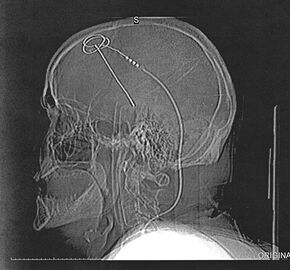 Computertomographie mit implantierter Elektrode
-
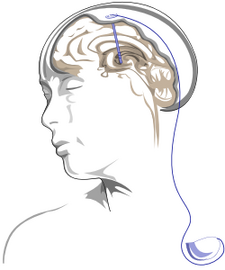 Schematische Darstellung: Elektrode, Kabel, Stromgeber
-
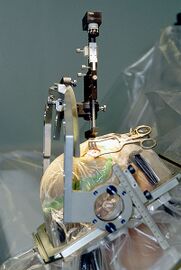 Stereotaxiegerät zur Platzierung einer Stimulationselektrode


Studienlage
- Die verblindete Studie von 2010 war negativ. Bei 11 Menschen mit schwerem chronischem Verlauf zeigte sich im verblindeten Vergleich von echter und Schein-Stimulation über je einen Monat kein Unterschied. Erst in der anschließenden offenen Phase hatten nach einem Jahr 6 von 11 um mehr als die Hälfte weniger Attacken, 3 davon keine mehr. Es gab drei schwere unerwünschte Ereignisse.[4]
- Offene Beobachtungen sind günstiger. Eine Metaanalyse von 2023 fasste 108 Fälle aus 16 Arbeiten zusammen, darunter nur eine randomisierte: Die Attacken gingen im Mittel um 70 Prozent zurück, bei etwa drei von vier Behandelten mindestens um die Hälfte. Todesfälle gab es bei weniger als 1 Prozent, schwere Komplikationen bei etwa jedem Sechsten.[5] Eine gemeinsame Auswertung der Einzeldaten von 40 Operierten aus vier Gruppen fand 2020 im Mittel 77 Prozent weniger Attacken über durchschnittlich 44 Monate; 75 Prozent sprachen an. Die wirksamen Stimulationsorte lagen dabei im Mittelhirn, im ventralen und retrorubralen Tegmentum.[6]
- Das Risiko ist ernst. In einer Pilotstudie von 2005 mit sechs Behandelten starb ein Patient an einer Hirnblutung entlang des Elektrodenkanals, wenige Stunden nach der Operation.[7]
- Die Studien im Vergleich: Studien zum Cluster-Kopfschmerz.
Einzelnachweise
- ↑ Treven M, Brücke C: Die tiefe Hirnstimulation. psychopraxis. neuropraxis 2020; 23(3): 138–141. DOI. Im Wortlaut: „Bei weltweit bereits über 160.000 implantierten Aggregaten, in den meisten Fällen zur Behandlung eines M. Parkinson …“ Am 23.09.2026 gelesen.
- ↑ BioWorld: Report from Europe: Medtronic gains first CE mark for DBS in psychiatric treatment, 16.07.2009, am 23.09.2026 gelesen: „Medtronic (Minneapolis) reported that Reclaim deep brain stimulation (DBS) therapy has received CE-mark approval for the treatment of chronic, severe treatment-resistant obsessive-compulsive disorder (OCD).“
- ↑ Medtronic: Medtronic Receives European CE Mark Approval for Deep Brain Stimulation Therapy for Refractory Epilepsy, Pressemitteilung vom 16.09.2010, am 23.09.2026 gelesen: „… received CE (Conformité Européenne) Mark approval for Medtronic Deep Brain Stimulation (DBS) Therapy in Europe as adjunctive treatment for partial-onset seizures in adults with medically refractory epilepsy.“; „The therapy also is approved in Europe for dystonia and obsessive-compulsive disorder (OCD).“
- ↑ Fontaine D, Lazorthes Y, Mertens P u. a. (2010). "Safety and efficacy of deep brain stimulation in refractory cluster headache: a randomized placebo-controlled double-blind trial followed by a 1-year open extension". J Headache Pain 11 (1): 23–31. doi:. PMID 19936616. 11 Patienten, Kreuzvergleich aktiv gegen Schein über je einen Monat. Im Wortlaut: „During the randomized phase, no significant change in primary and secondary outcome measures was observed between active and sham stimulation. At the end of the open phase, 6/11 responded to the chronic stimulation“ (wöchentliche Attackenzahl um mehr als 50 % gesunken), „including three pain-free patients. There were three serious adverse events“. Am 23.09.2026 über Europe PMC geprüft.
- ↑ Murray M, Pahapill PA, Awad AJ (2023). "Deep brain stimulation for chronic cluster headaches: a systematic review and meta-analysis". Stereotact Funct Neurosurg 101 (4): 232–243. doi:. PMID 37245509. 108 Fälle aus 16 Arbeiten, davon eine randomisiert; Attackenhäufigkeit −70,1 %, 74,3 % mit mindestens Halbierung. Im Wortlaut: „Death occurred in <1%. The rate of major complications was 16.67%.“ Am 21.09.2026 über Europe PMC geprüft.
- ↑ Nowacki A, Schober M, Nader L u. a. (2020). "Deep brain stimulation for chronic cluster headache: meta-analysis of individual patient data". Ann Neurol 88 (5): 956–969. doi:. PMID 32827225. Im Wortlaut: „Among 40 patients from four different cohorts representing ~50% of all previously published cases, we found a significant 77% mean reduction in headache attack frequency over a mean follow-up of 44 months, with an overall response rate of 75%.“ Außerdem: „We identified 2 hotspots of stimulation covering the midbrain ventral and retrorubral tegmentum.“ Am 23.09.2026 über Europe PMC geprüft.
- ↑ Schoenen J, Di Clemente L, Vandenheede M u. a. (2005). "Hypothalamic stimulation in chronic cluster headache: a pilot study of efficacy and mode of action". Brain 128 (Pt 4): 940–947. doi:. PMID 15689358. Im Wortlaut: „Another patient died from an intracerebral haemorrhage that developed along the lead tract several hours after surgery“; „Intracerebral haemorrhage cannot be neglected in the risk evaluation of the procedure.“ Am 21.09.2026 über Europe PMC geprüft.
Siehe auch:
- Infiltrationstherapie bei Cluster-Kopfschmerz
- Therapeutische Nervenblockade
- Okzipitale Nervenstimulation
- SPG-Stimulation
Literatur
- Jürgens T, Paulus W, Tronnier V, Gaul C, Lampl C, Gantenbein A, May A, Diener HC.: Einsatz neuromodulierender Verfahren bei primären Kopfschmerzen. Therapieempfehlungen der Deutschen Migräne- und Kopfschmerzgesellschaft. Nervenheilkunde. 2011; 30(1-2): 47–58. DMKG: PDF-Datei
- Bain Peter, Aziz Tipu, Liu Xuguang, Nandi Dipankar (ed.): Deep Brain Stimulation. Oxford University Press. 2009; ISBN 0-19-954371-2
- May A, Jürgens TP (October 2010). "Therapeutische Neuromodulation bei primären Kopfschmerzsyndromen. (Therapeutic neuromodulation in primary headaches.)". Nervenarzt. doi:. PMID 20972665.
Externe Links
 Diese Seiten sind von Nichtmedizinern geschrieben und ersetzen keinen Arztbesuch. Angaben können fehlerhaft oder veraltet sein – prüfen Sie Wichtiges in den genannten Quellen nach. Bitte beachten Sie die Hinweise zu Gesundheitsthemen und zum Datenschutz sowie unsere Arbeitsweise.